Skip to content

Product

What LCAB does, and how you use it

LCAB is a guided platform for collecting, structuring, and documenting product information. Start with Excel, a bill of materials (BOM) or documents, complete the wizard, and get a screening draft with your data, which you can take to third-party verification and approval. Then you can build toward reports, compliance and a digital product passport.

Below you get an overview of the workflow and a clear explanation of each main feature: what it does, when to use it, and how to get started. The Integration button with system icons is the fastest way into your data.

01

The workflow in LCAB

Features are built as natural steps. You do not need to do everything at once. Start where your data already lives, then build from there.

  1. 01

    Integration

    Choose Integration, pick Excel, a bill of materials (BOM) or documents, and pull data in instead of typing every field by hand.

  2. 02

    Product

    Create the product and set the frame: type, ambition, and what the assessment is for.

  3. 03

    Materials and suppliers

    Register or import materials and suppliers so you have one source of truth you can reuse.

  4. 04

    LCA and CO2

    Run the guided wizard. Gaps are marked so you know exactly where more data is needed.

  5. 05

    Reports

    Generate a screening draft and carbon footprint when you have enough data. The draft contains your data and is the documentation basis for third-party verification and approval.

  6. 06

    DPP and compliance

    Prepare a digital product passport, track gaps, and share documentation that can be verified.

02

Features in depth

Each feature has a clear purpose. Here is what it does, when it makes sense, and how teams typically use it.

Area 01

Integrations and data import

Pull data from the systems you already use. Excel and CSV are ready. ERP, PIM, PLM, CAD, EPD, and REST API are being prepared.

01

Integration button

A small button with system icons that opens a picker. You choose system, file, and press Extract data. The same button is on suppliers, materials, new product, wizard, and the integrations hub.

Use it whenever you want to avoid manual entry and start from existing files or upcoming system connectors.

How to use it

  1. 1Click Integration and choose a system via the icons (for example Excel).
  2. 2Upload or pick the file from the document library.
  3. 3Press Extract data, approve mapping, and let LCAB create or fill the records.

02

Excel and CSV

Import material lists, supplier lists, product data, BOM, CO2, and production data. LCAB suggests column mapping, and you can export back when sync is ready.

Use it when the data already lives in spreadsheets. the most important integration for most SMEs.

How to use it

  1. 1Open Suppliers, Materials, or Integrations, and choose Excel or CSV.
  2. 2Map the columns (or approve LCAB suggestions).
  3. 3Run the import and check the result in the library or on the product.

03

Data Mapping Wizard

When you upload a sheet, LCAB automatically suggests links such as Supplier Name to Supplier name, Steel to Material, Weight to Weight, and Country to Country of origin. Next time LCAB remembers the setup.

Use it on the first import from a new sheet format, and when you want to reuse the same mapping later.

How to use it

  1. 1Upload Excel/CSV via Integration.
  2. 2Review the suggested field mappings.
  3. 3Approve, then reuse the same setup next time you import similar data.

04

Documents in product and wizard

PDF and Word files can be linked to the product. On new product or in the wizard, Excel can fill fields and mark wizard sections that still need completion.

Use it when starting a new product from a sheet, or when documentation should live in the same structure as the LCA work.

How to use it

  1. 1On New product: choose Integration then Excel to fill name and description.
  2. 2In the wizard: choose Integration to pull more data in and see gaps marked.
  3. 3Link PDF/Word via Documents once the product exists.

05

Upcoming systems

The catalog covers Dynamics 365 Business Central, Odoo, e-conomic, SAP, Visma, Uniconta, Monitor, Pimcore, Akeneo, Teamcenter, Fusion Manage, Arena, SolidWorks, Inventor, Fusion 360, supplier portal, EPD International, ECO Platform, Ecoinvent, OpenLCA, Power BI, and REST API.

Use it for planning: see what is coming, and contact us for early access to the integration you need most.

How to use it

  1. 1Open Integrations for the full catalog with brand icons.
  2. 2Check Ready or Coming soon on each system.
  3. 3Contact us about the integration that matches your ERP, PIM, or LCA tool.

Area 02

Product data

Brings together what otherwise lives in spreadsheets, PDFs, and emails so each product has a shared home.

LCAB · Product data

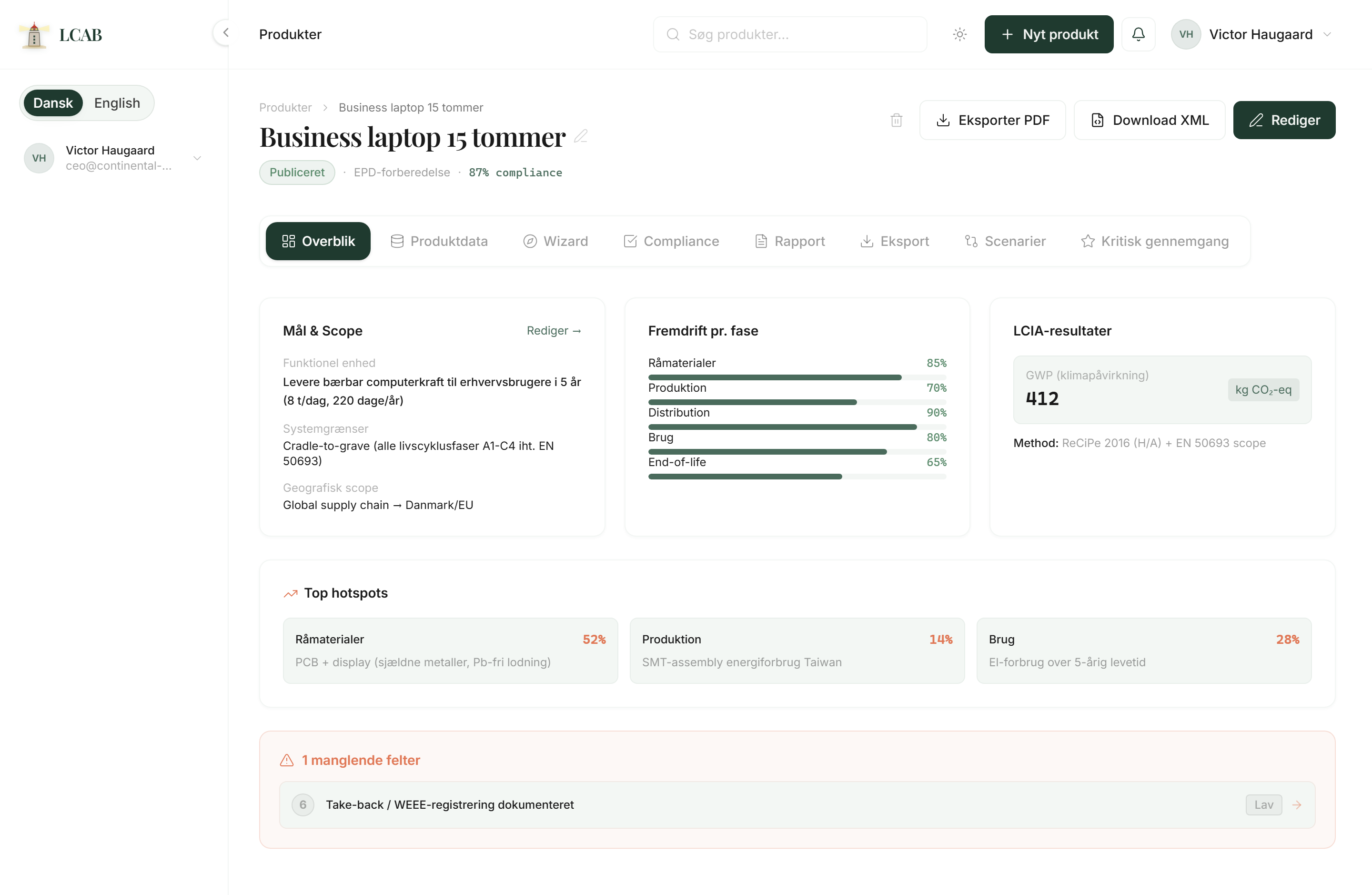
LCAB product dashboard with scope, progress, LCIA and hotspots for a product

01

Products and dashboard

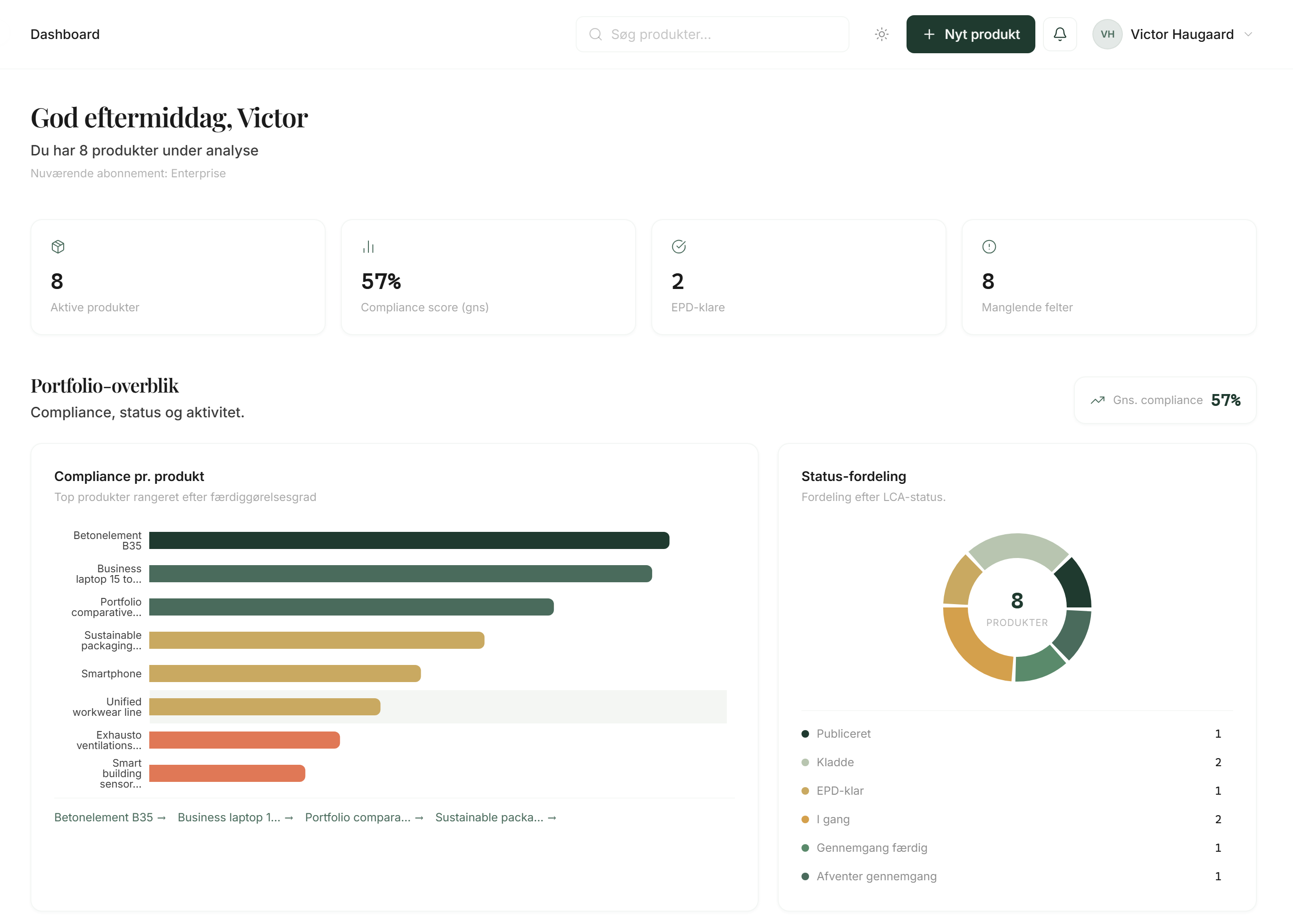
The dashboard shows your products, compliance score, and next steps. The product page gathers materials, suppliers, documents, LCA, and passport in one place.

Use it whenever you need to find a product, check status, or continue the work.

How to use it

  1. 1Sign in and open the dashboard for a quick overview.
  2. 2Go to Products to open an existing product or create a new one.
  3. 3Use the product page as the base when linking materials, documents, or continuing the wizard.

02

Material library

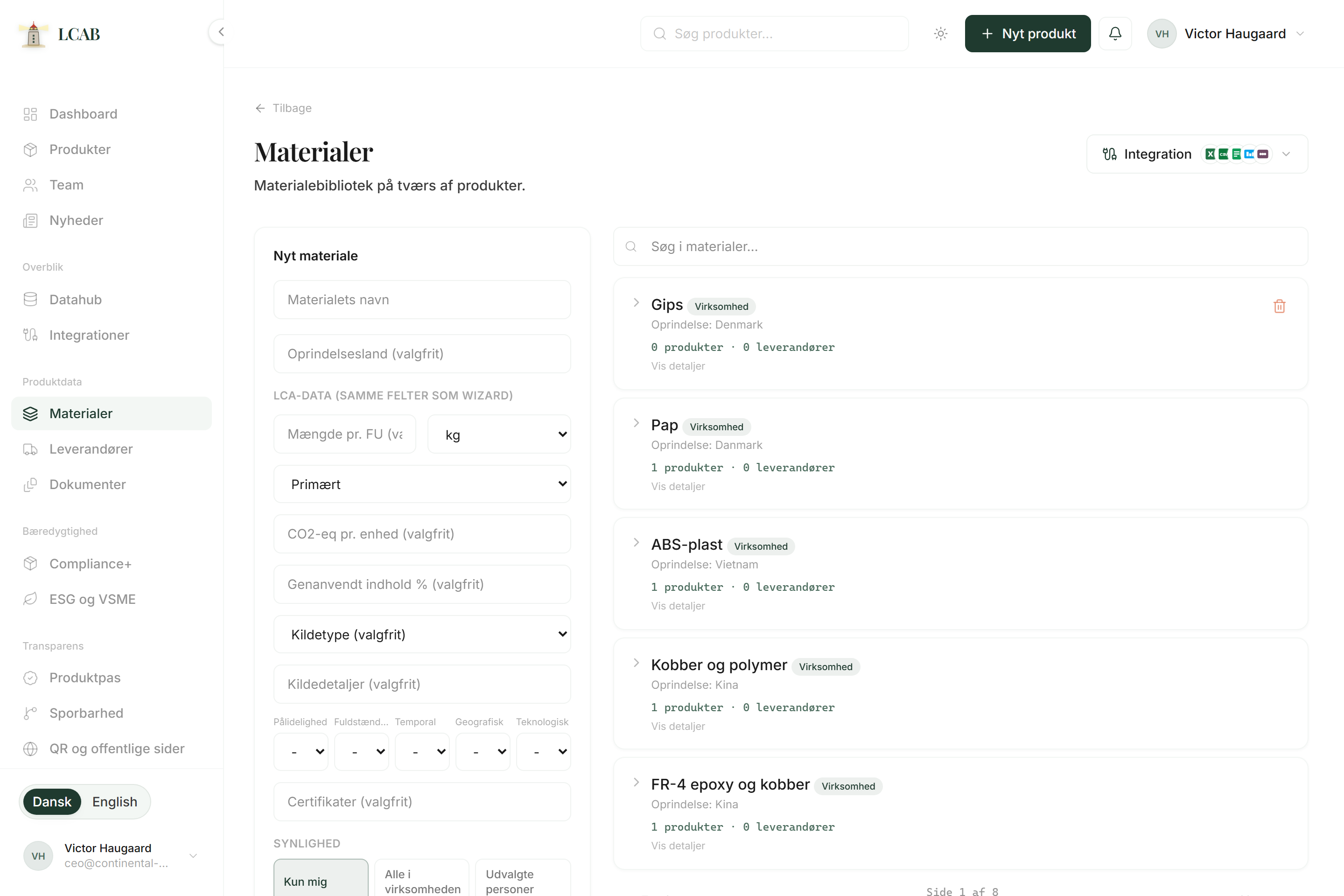
A shared library of materials with name, origin, and available environmental data. Materials can be reused across products and imported via Integration.

Use it when you want to stop re-entering the same material in new spreadsheets.

How to use it

  1. 1Open Materials, or click Integration and choose Excel/CSV.
  2. 2Create manually, or approve mapping and extract data from the file.
  3. 3Link the material to the product from the product page or platform tab.

03

Suppliers

Supplier cards with country, contact, certifications, linked materials, and documents. Import via Integration then Excel then Extract data.

Use it when customers ask about origin, traceability, or supplier documentation.

How to use it

  1. 1Click Integration on Suppliers, choose Excel, and extract data from the file.
  2. 2Or create the supplier manually and link materials and documents to the card.
  3. 3Open the supplier to see the full picture before answering the customer.

04

Document centre

Collects certificates, tests, REACH/CE, EPD files, and supplier sheets. Documents can be linked to a product, material, or supplier.

Use it for all product documentation, not only LCA reports.

How to use it

  1. 1Go to Documents and register the file with type and optional expiry date.
  2. 2Link the document to the right product, material, or supplier.
  3. 3Upload a new version when a certificate is renewed so you do not send the old one.

Area 03

Sustainability and LCA

Guided life cycle assessment, climate data, and clarity on what is still missing.

01

Guided LCA wizard

A step by step wizard that follows the logic of ISO 14040 and ISO 14044: goal and scope, inventory, impact assessment, and interpretation. After Excel extraction, sections that still need data are marked.

Use it when you need to run or update a life cycle assessment without starting in the full standard text.

How to use it

  1. 1Open the product and start the wizard from step 1, or fill fields via Integration on New product.
  2. 2Fill in what you can. LCAB shows and marks what is missing before you move on.
  3. 3Review the results and use the interpretation to decide the next improvement or report.

02

Reports and export

Generates reports in several formats: full ISO 14044, EPD-oriented documentation, and carbon footprint to ISO 14067. Each issue gets a document ID.

Use it when results need to be shared with customers, buyers, leadership, or for internal decisions.

How to use it

  1. 1Make sure the wizard and core data are sufficiently complete.
  2. 2Choose the report type under Reports or on the product.
  3. 3Issue the document and share the document ID so the recipient can verify it.

03

Compliance overview

Scores and checklists that show progress on ISO-related points, EPD/CFP readiness, and passport readiness. It does not promise certification. It makes gaps visible in time.

Use it to prioritise next steps before a customer or auditor asks.

How to use it

  1. 1Open Compliance or check the score on the dashboard and product page.
  2. 2Identify the fields or documents pulling the score down.
  3. 3Fix the gaps in the wizard, materials, or document centre, then check the score again.

Area 04

Transparency and Digital Product Passport

Get product data ready for sharing, a public page, and future ESPR requirements.

01

Digital product passport

Brings together product identity, materials, environmental data, and traceability in a passport flow with readiness score, publishing, and a public page.

Use it when preparing for Digital Product Passport under ESPR, or when you want to present product data more clearly.

How to use it

  1. 1Open Passport and create a passport for the relevant product.
  2. 2Fill in or reuse data from materials, suppliers, and LCA.
  3. 3Publish when the readiness score is acceptable, then share the public page or QR.

02

Traceability

Shows how product, materials, suppliers, documents, and LCA connect.

Use it when onboarding colleagues or explaining the value chain to a customer.

How to use it

  1. 1Open Traceability for the product.
  2. 2Follow the links from product out to materials and suppliers.
  3. 3Use the overview to check that documentation covers what you think it covers.

03

Public pages and QR

A public product page and QR code as the visible face of the product passport for customers and authorities.

Use it when you want to share a controlled slice of product data without sending the whole internal folder.

How to use it

  1. 1Publish the product passport first.
  2. 2Open the public page and check what is visible.
  3. 3Share the link or QR with the customer.

04

Public verification

Recipients can look up a document ID and see the issued version. That builds trust because you are not only sending a PDF.

Use it when a customer, investor, or partner needs to check that a document is genuine.

How to use it

  1. 1Issue the report from LCAB so it receives a document ID.
  2. 2Send the ID together with the document.
  3. 3Ask the recipient to use Verify document in the menu.

Area 05

Collaboration

Sustainability is rarely a full-time job. Message colleagues, share products, and keep the work in one place.

LCAB · Team

LCAB team page with colleagues, messages and add-to-product actions
  1. 1Invite colleagues via Team or product sharing.
  2. 2Give them access to the products they need to work on.
  3. 3Let each role fill materials, documents, or wizard steps.
From data to decision

Features connect, so you do not start from scratch each time.

When materials, suppliers, and LCA live in one structure, reports, compliance, and product passports become natural next steps. not separate projects.

03

How to get started

You do not need all data ready. Start small and let the platform show the next step.

  1. 01

    Open the demo if you first want to see a finished example, or apply to become a founding partner.

  2. 02

    As a founding partner you get access during the test period and can work with your own products.

  3. 03

    Use Integration to extract materials and suppliers from Excel, or add them manually.

  4. 04

    Enter the wizard and fill what you can. Do not skip the gaps. Mark them, or let Excel extraction mark them for you.

  5. 05

    When ready, generate a report or prepare the product passport.

04

Ready to structure your product data?

LCAB makes complex sustainability requirements understandable for companies without a dedicated ESG team. During the test period, access is through founding partners.