Skip to content

Product

Integrations and data import

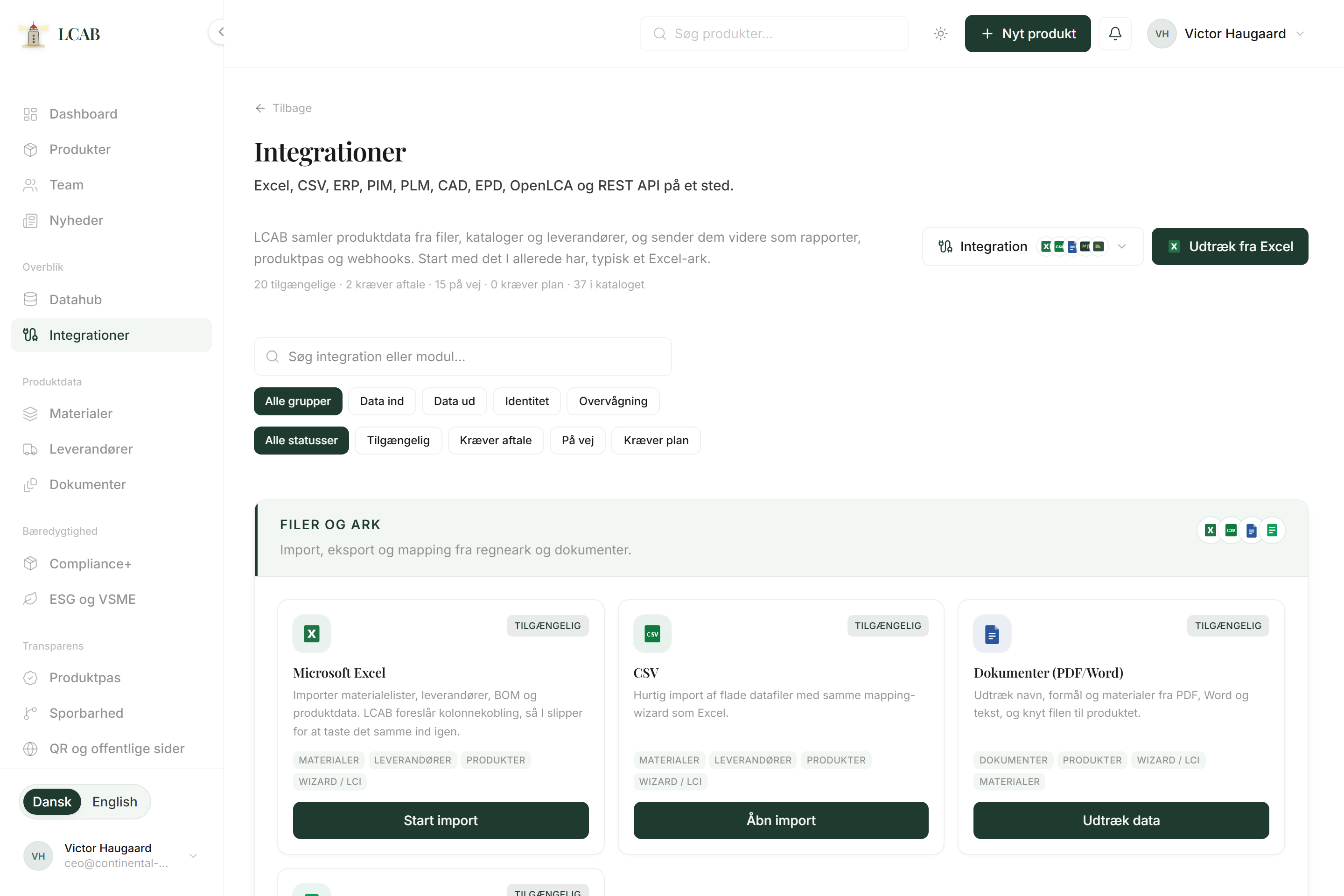
Start with the files you already have. Excel and CSV are ready. ERP, PIM, PLM, CAD, EPD, and REST API are being prepared.

LCAB integrations with Excel, CSV and upcoming systems

Context

Integrations in LCAB are about moving data into the product structure, not about building a large IT project first. Most SMEs start with a spreadsheet: a material list, a supplier list, or a bill of materials (BOM).

You choose Integration, pick a system or file type, approve the mapping, and let LCAB create or fill records. The same button sits on suppliers, materials, new product, wizard, and the integrations hub.

The goal is to answer the customer with your own numbers without typing everything again. Import is the entry point. Structure, gaps, and next steps follow once the rows sit on the product.

If you later get an ERP, PIM, or CAD system, the plan stays the same: the data should land in the same product structure. The catalogue shows what is ready and what is being prepared, so you can plan without guessing.

Context

Why it matters for a small product team

When a customer asks, you rarely have time to type hundreds of rows by hand. The data already exists, just in another format. Import saves time and reduces mistakes because you reuse what you have instead of inventing it again.

It is also the fastest way to see the gaps: empty fields and missing links become visible once the rows land in LCAB. Then you know what to request from the supplier before you promise a deadline.

For a small team this is practical: purchasing keeps its sheet, production keeps its BOM, and LCAB becomes the shared place where the rows meet. You avoid maintaining three parallel versions.

Once mapping is approved, LCAB remembers the setup. The next import gets faster. That kind of repetition turns documentation into a habit, not a one-off project before a tender.

Start with the sheet you already have. Do not build an IT project just to begin.

In depth

What you find here

Each part has a clear purpose. Here is what it does, when it makes sense, and how teams typically use it.

01

Integration button

A small button with system icons that opens a picker. You choose system, file, and press Extract data. The same button is on suppliers, materials, new product, wizard, and the integrations hub, so you do not hunt for import elsewhere.

Use it whenever you want to avoid manual entry and start from existing files or upcoming system connectors.

How to use it

  1. Click Integration and choose a system via the icons (for example Excel).
  2. Upload or pick the file from the document library.
  3. Press Extract data, approve mapping, and let LCAB create or fill the records.

02

Excel and CSV

Import material lists, supplier lists, product data, BOM, CO2, and production data. LCAB suggests column mapping, and you can export back when sync is ready. This is the practical main path in for SMEs without dedicated IT.

Use it when the data already lives in spreadsheets. It is the most important integration for most SMEs.

How to use it

  1. Open Suppliers, Materials, or Integrations, and choose Excel or CSV.
  2. Map the columns (or approve LCAB suggestions).
  3. Run the import and check the result in the library or on the product.

03

Data Mapping Wizard

When you upload a sheet, LCAB automatically suggests links such as Supplier Name to Supplier name, Steel to Material, Weight to Weight, and Country to Country of origin. Next time LCAB remembers the setup, so you do not start over every time.

Use it on the first import from a new sheet format, and when you want to reuse the same mapping later.

How to use it

  1. Upload Excel/CSV via Integration.
  2. Review the suggested field mappings.
  3. Approve, then reuse the same setup next time you import similar data.

04

Documents in product and wizard

PDF and Word files can be linked to the product. On new product or in the wizard, Excel can fill fields and mark wizard sections that still need completion. That way you get both the files and the structured fields in the same flow.

Use it when starting a new product from a sheet, or when documentation should live in the same structure as the LCA work.

How to use it

  1. On New product: choose Integration, then Excel, to fill name and description.
  2. In the wizard: choose Integration to pull more data in and see gaps marked.
  3. Link PDF/Word via Documents once the product exists.

05

Upcoming systems

The catalog covers Dynamics 365 Business Central, Odoo, e-conomic, SAP, Visma, Uniconta, Monitor, Pimcore, Akeneo, Teamcenter, Fusion Manage, Arena, SolidWorks, Inventor, Fusion 360, supplier portal, EPD International, ECO Platform, Ecoinvent, OpenLCA, Power BI, and REST API. Status shows Ready or Coming soon.

Use it for planning: see what is coming, and contact us for early access to the integration you need most.

How to use it

  1. Open Integrations for the full catalog with brand icons.
  2. Check Ready or Coming soon on each system.
  3. Contact us about the integration that matches your ERP, PIM, or LCA tool.

Outcome

What you get

  • Excel and CSV as the main path

    Import for materials, suppliers, products, BOM, and production data. This is the most important integration for most SMEs without dedicated IT.

  • Mapping that is remembered

    LCAB suggests column links and remembers the approved setup, so you do not start over every time you import a similar sheet.

  • Documents and fields together

    PDF and Word link to the product, while Excel can fill fields in new product and wizard. The file and the structured data follow the same flow.

  • Catalogue of the next layer

    See ERP, PIM, PLM, CAD, EPD, and API with status Ready or Coming soon, so you can plan without promising what you cannot deliver yet.

  • The same button in more places

    Integration sits where you work: suppliers, materials, new product, wizard, and hub. You do not hunt for import in a hidden menu.

Safe

What you do not need to be an expert in

You do not need to know ERP APIs, ILCD formats, or how to build a data pipeline. You need to point to your sheet, understand the columns, and confirm whether Steel means material.

The rest is guidance, remembered mapping, and visible gaps. When a larger system later becomes relevant, you take it as the next layer, not as a starting requirement.

Start

Typical start in LCAB

  1. Find the sheet

    Use the spreadsheet you already have for materials, suppliers, or BOM. It does not need to be perfect.

  2. Choose Integration

    Open Integrations, or press Integration on the relevant page, and choose Excel or CSV.

  3. Approve mapping

    Review the suggestions, fix what is wrong, approve, and run the import.

  4. Check on the product

    Open a product and confirm materials and suppliers are linked correctly before you continue in the wizard.

Answers

Short answers

01

Do we need an ERP to get started?

No. Excel and CSV are the most important integration for most teams. ERP, PIM, and similar systems come as the next layer once the data already has a home in LCAB.

02

What if our column names are messy?

The mapping wizard suggests links, and you can correct them manually. Once the setup is approved, LCAB remembers it for the next similar import.

03

Can we export again?

Yes, when sync is ready you can export back. Until then, import is the safe way to get the structure standing.

04

What if the sheet only covers part of the product?

Import what you have. The gaps become visible on the product, so you know exactly what is missing from supplier or production.

Next step

Want to see it on your own products?

Book a walkthrough. We look at your bill of materials and files and show how they land in LCAB.

No commitment. You can start with the demo if you want to see the system first.

No commitment

01

Book a walkthrough

Please contact me by