Skip to content

1. What LCAB is

LCAB helps companies understand, document, and future-proof their products through sustainability data, LCA, and Digital Product Passports.

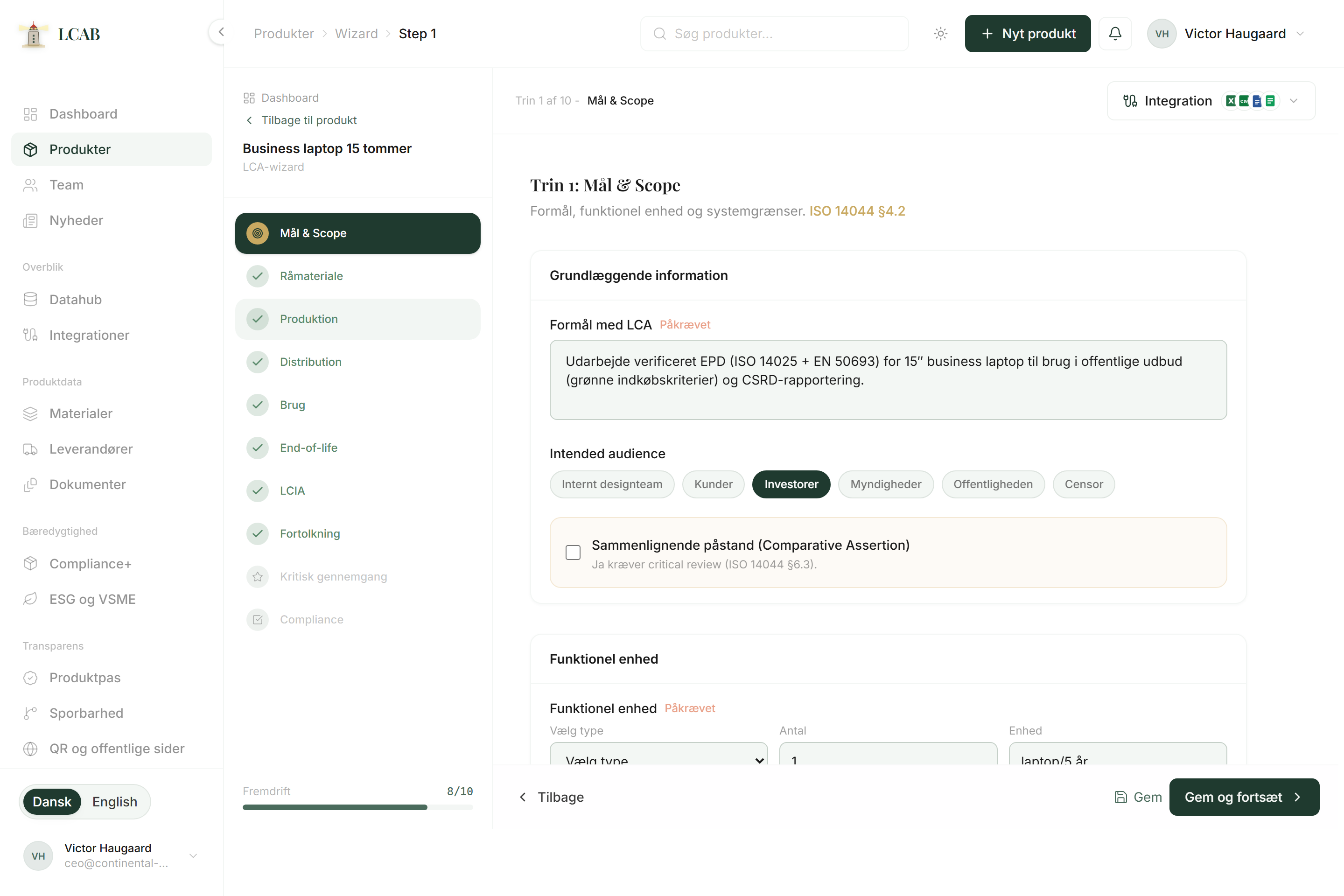
The platform is built for SMEs and others who do not have a large ESG team. It makes requirements understandable and gathers data in one place. It is not an expert tool at SimaPro level and not a certification scheme.

2. What LCAB helps with

LCAB can help you:

• Collect product data, materials, suppliers, and documents • Import lists from Excel or CSV • Run a guided LCA workflow following the logic of ISO 14040/14044 • Produce carbon footprint documentation in an ISO 14067-oriented practice • Prepare EPD-oriented documentation (not as a programme operator) • Prepare a Digital Product Passport and structure data for ESPR • See gaps in documentation through a compliance score and checklists, including construction products, electronics, textiles, and packaging • Share a controlled subset via a public page, QR, and document verification • Get guidance in the platform through Haddock

This is support for documentation and overview. It is not a stamp that you comply with the law.

3. DPP and ESPR

The EU Ecodesign for Sustainable Products Regulation (ESPR) and the Digital Product Passport make product data and traceability more necessary over time. LCAB helps you gather and show the data you already have, and see what is missing.

Priority product groups include textiles, electronics, furniture, packaging, and construction. Timelines arrive in stages through delegated acts. LCAB does not guarantee that a published passport meets all current or future rules. You are responsible for content and for when you publish.

4. ESG and CSRD

LCAB can support climate data and product documentation that customers or larger companies ask for. It does not replace CSRD/ESRS reporting, double materiality analysis, or ESG information that must be audited.

For many SMEs the pressure is indirect: customers ask before the law hits you directly. LCAB helps you answer with structure, not publish your annual report.

5. LCA, EPD, and CO2

The guided wizard follows the phases in ISO 14040/14044. Reports can be ISO-oriented, carbon footprint, or EPD preparation.

Using LCAB does not mean the study is verified, critically reviewed, or ready for a comparative claim. An EPD typically needs a PCR, a programme operator, and independent verification outside LCAB.

6. Construction

Construction products are one of the places where documentation most often becomes a real requirement. Tenders, clients, and climate rules in the Danish building code mean suppliers are asked for EPDs, GWP, and traceability. Not for a novel.

In LCAB you can:

• Gather master data, materials, and suppliers for the construction product • Prepare EN 15804-oriented EPD documentation (typically +A2, modules A1-C) • Upload CE marking, the declaration of performance (DoP), and test documents so you can see what is missing under the Construction Products Regulation (CPR 305/2011) • Prepare digital documentation for the new Construction Products Regulation (EU) 2024/3110, which points toward product passports for construction products • Answer when a client or tender asks for product data for the building climate calculation

LCAB does not issue a CE mark, a DoP, or a verified EPD. LCAB does not calculate whole-building LCA (for example LCAbyg) and does not replace DGNB, the Nordic Swan, or other building certifications. That sits with advisers, programme operators, and authorities.

7. Other product groups

The same principle applies outside construction. LCAB shows relevant requirement cards on the product so you can see what typically needs documenting. The cards are guidance. They are not an approval stamp.

• Electronics: RoHS, WEEE, and REACH/SVHC. If the product is or contains a regulated battery, also the Batteries Regulation (EU) 2023/1542 and the battery passport • Textiles: fibre labelling, REACH substances in clothing, and preparation for ESPR/DPP • Packaging: the Packaging Regulation (PPWR) and materials/recyclability • Furniture: materials, chemicals/flame retardants, and traceability • Food-related packaging: food-contact materials (EC 1935/2004) • Across products: REACH for articles, import, and placing on the EU market

Which cards you see depends on product type, materials, and whether the product is a battery. See also /digital-product-passport, /epd, and /sustainability-requirements.

8. What LCAB does not do

LCAB does not certify you. LCAB is not an authority, not a notified body, not an EPD programme operator, and not your lawyer.

A compliance score is an internal view of gaps. It is not proof toward a supervisor or a customer.

See /disclaimer, /haddock, and the guide pages if you want the subject explanation. This page only describes what the product makes available.

Questions about what the platform covers can be sent to info@windfeldjensen.com

Windfeld Jensen Co. · CVR 46591054 · 23 97 94 91
Lyngbyvej 83A, 2100 København Ø