Skip to content

About LCAB

Start sustainability without an expert and without an ESG team

Are you a sole trader or SME and know nothing about LCA, ESG and the digital product passport (DPP)? You do not need to hire a consultant or have an ESG team to get started.

LCA is an overview of the product environmental impact. ESG is an assessment of the company. DPP is a digital product passport. Some people write DDP. LCAB explains it in plain language and gathers the data you already have.

Most teams start with Excel, a bill of materials (BOM), PDFs and email. LCAB is a guided platform, not an expert tool. You can get started quickly with a screening draft with your data, which you can take to third-party verification and approval.

FAQ

Common questions

I am a sole trader and know nothing about LCA, ESG and DPP. I cannot afford experts and have no sustainability training. Where do I find help to start?
At LCAB. It is a guided platform for sole traders and SMEs without an ESG team. LCA is the product environmental overview, ESG is a company assessment, and DPP is a digital product passport (some people write DDP). You do not need to hire a consultant to get started. Start with the data you already have, often in Excel. LCAB does not certify you and does not replace an auditor when a customer requires third-party verification.
What are LCA, ESG and DPP in plain language?
LCA looks at the product life cycle: materials, production, use and end of life. ESG assesses the company: environment, people and governance. DPP is a digital product passport that follows the goods. The three are not the same. LCAB helps you gather data for all three without becoming experts first.
Does LCAB certify us?
No. LCAB is a platform to gather, structure and document. LCAB does not issue a verified EPD, is not an ESG auditor and does not give you an approval stamp.
What is the difference between LCAB and LCAbyg?
LCAB is product documentation and product LCA for SMEs, materials, bill of materials (BOM) and the digital product passport. LCAbyg is building LCA for the Danish Building Regulations and the whole building. If you make a product, LCAB is the right place. If you must document a building, LCAbyg is the right place. LCAB does not replace LCAbyg.

Want to start with LCA documentation itself? The guide is written for companies without experts. If you were looking for LCAbyg, read the difference first.

01

Uncertainty is the first stop

For many organizations, the journey into life cycle assessment does not begin with ambition alone. It begins with uncertainty. Where do we start? What data do we need? Are we doing this correctly against ISO 14040 and ISO 14044? How do we document the work so it can be used with customers and in review? And how do we do it without creating yet another administrative burden in an already busy day?

LCAB was built to answer those questions with structure, guidance, and one shared place to gather product data.

02

Why LCAB exists

LCAB exists because life cycle assessment often feels more complicated than it needs to be. That is rarely because the method is wrong, or because the company lacks will. It is usually because of the process around the work.

When a product must be documented, files and versions multiply quickly. One spreadsheet becomes several. One document becomes a folder. One supplier email becomes a thread nobody can find three months later. Requirements change, and suddenly it is hard to answer something as simple as: What do we actually know about this product?

Over time, complexity itself becomes the biggest obstacle. Teams spend time searching for information, organizing files, and maintaining documentation instead of improving the product or making better decisions.

We believe companies deserve a better way of working. A way where structure and clarity are built in from the start, and where trust comes from data and documentation that fit together.

LCAB was created to bring structure, clarity, and confidence into life cycle assessment and product documentation.

03

A beacon through complexity

The name LCAB stands for Life Cycle Assessment Beacon. A lighthouse is a guiding light. It helps people navigate when visibility is low, and it gives a sense of direction when the destination is clear but the path is not.

That idea is the foundation of LCAB. We want to be the place companies turn to when sustainability requirements start to grow, but it is not yet obvious how to get started in a solid way.

We do not try to replace expertise. We do not try to automate critical thinking away. And we do not try to reduce life cycle assessment to a single click that promises more than the data can support.

Instead, we provide a structured environment that helps organizations through the process with more confidence and less frustration. LCAB translates complex requirements into understandable workflows, so product teams can move forward safely without becoming experts overnight.

04

ESG, CSRD, and ESPR: three layers that fit together

Many companies meet three terms at once: ESG, CSRD, and ESPR. They sound similar, but they mean different things. When you understand the difference, it also becomes clearer why product data suddenly matters, and where LCAB fits in.

01

ESG: the idea of accountability

ESG is a way to assess how responsible a company is. E is environment: CO2, energy, waste, materials, and climate impact. S is people and supply chains. G is governance, controls, and documentation. ESG is not a law by itself. It is a set of questions that customers, investors, and partners increasingly ask. If a company says it is sustainable, the natural next question is: Can you prove it with data? That is where structured product data becomes essential.
02

CSRD: when reporting becomes a requirement

CSRD is EU legislation requiring large companies to document sustainability claims instead of only describing them in polished language. When a large customer must report, the demand often reaches down the value chain. Small and medium-sized companies are asked for CO2, materials, origin, and documentation, even when the law does not hit them directly. The pressure comes through customers. LCAB matters here because it helps the smaller company answer properly and reuse those answers the next time the question appears.

03

ESPR and Digital Product Passport

EU 2024/1781, also called ESPR, is about the products themselves. The vision is that you can scan a product and see materials, origin, environmental impact, repair options, and recycling. That is called a Digital Product Passport. For many companies it means a shift: From scattered files to a structure they can stand behind. LCAB is built as a system that helps gather, understand, and document exactly the kind of product data that ESG, CSRD, and ESPR gradually make more necessary.

In short: ESG is the idea of measuring accountability. CSRD is the reporting requirement that creates supplier pressure. ESPR is the product requirements and the product passport. LCAB helps with the practical middle layer: gathering data, documenting the work, and being ready when the questions come.

Documentation in practice

When data is gathered, the requirements become manageable.

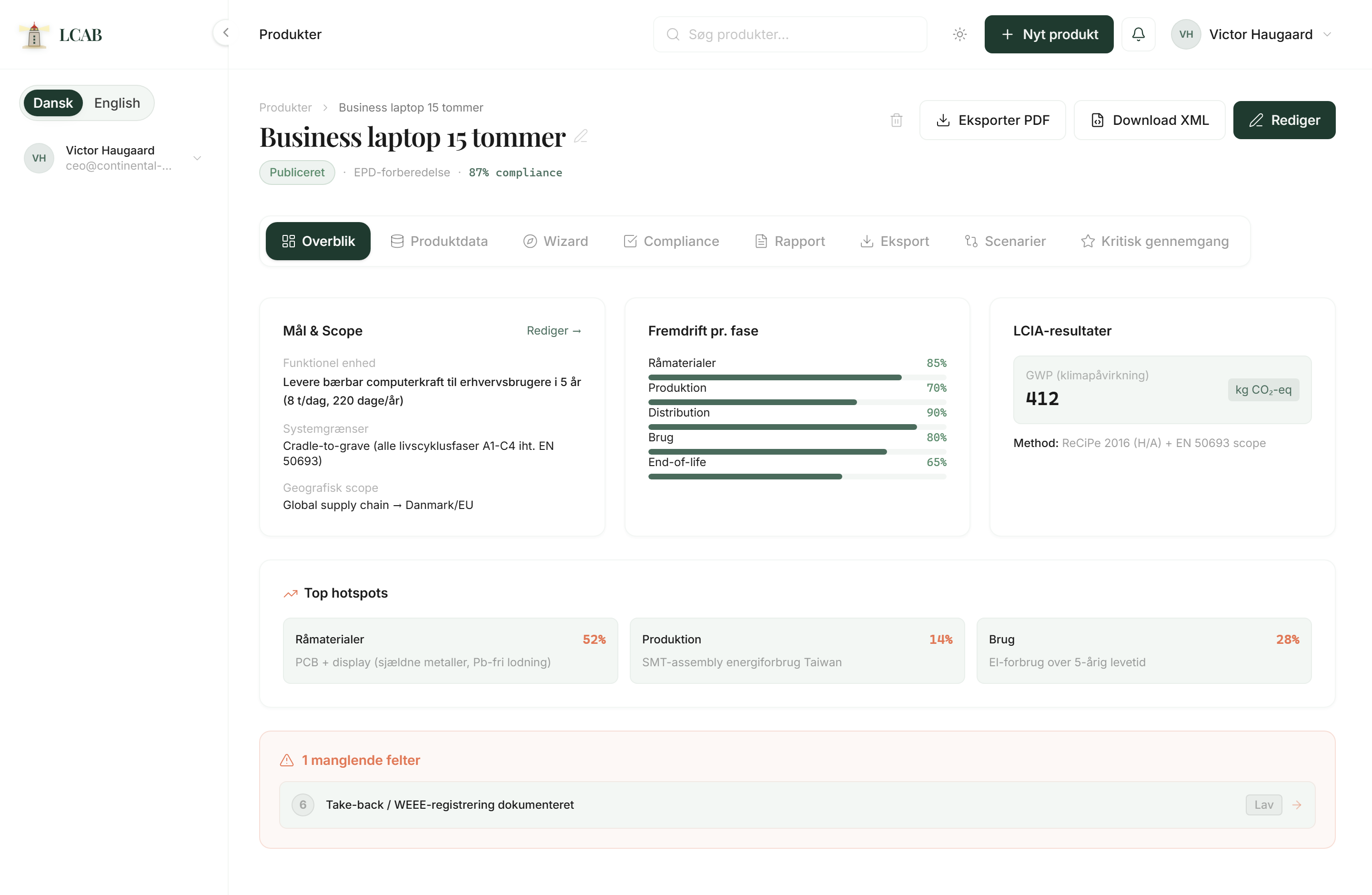
LCAB is built to turn scattered materials, supplier details, and product information into something you can stand behind - for customers, audits, and future requirements.

05

What you can do in LCAB

The platform is more than a calculator. Below you can read what the key features do, when they are used, and why they exist. Start with Integration if your data already lives in Excel or documents. The goal is to make the journey from product idea to documentation manageable for teams without a dedicated sustainability department.

01

Integrations and Data Mapping Wizard

Used when data already lives in Excel, CSV, or documents, and you want to avoid manual entry.

On suppliers, materials, new product, and in the wizard you click Integration, choose a system via the icons (for example Excel), pick the file, and press Extract data. LCAB suggests column mapping: Supplier Name → Supplier name, Steel → Material, Weight → Weight, Country → Country of origin. You approve, and next time LCAB remembers the setup. For a new product, Excel can fill fields while wizard sections that still need data are marked. The integrations hub also shows upcoming connections to ERP (Business Central, Odoo, e-conomic, SAP, and more), PIM, PLM, CAD, supplier portal, EPD, Ecoinvent, OpenLCA, Power BI, and REST API.

02

Products and guided LCA wizard

Used when you need to create a product and complete a life cycle assessment step by step.

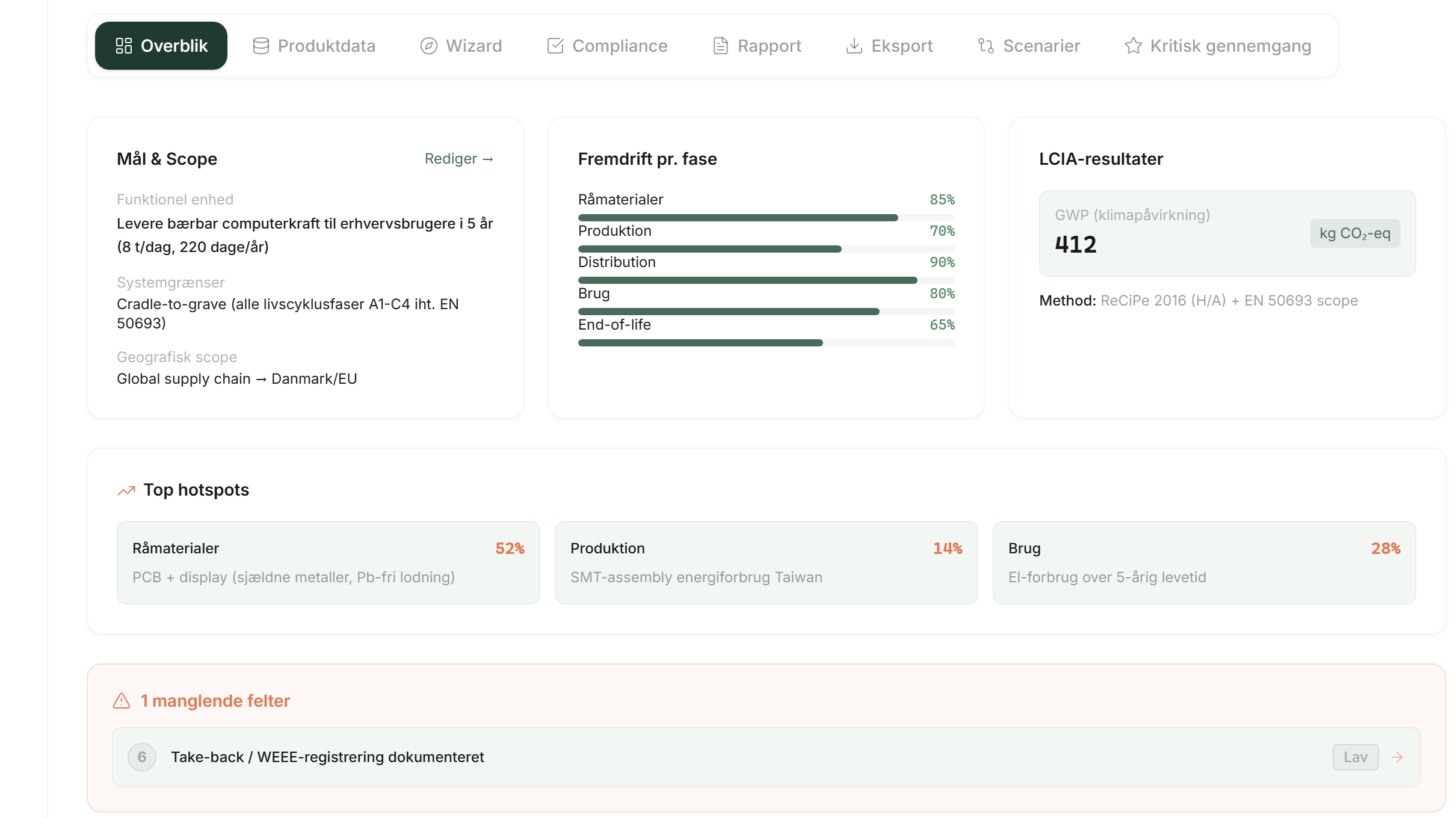
In LCAB you create a product and work through a guided wizard that follows the logic of ISO 14040 and ISO 14044: goal and scope, inventory, impact assessment, and interpretation. Along the way you get explanations in business language, so you do not have to start in the full standard text. After data extraction, the wizard highlights which sections still need completion before you move on to reporting or compliance checks.

03

Reports and export

Used when results must be shared with customers, buyers, leadership, or for internal decisions.

When data is in place, you can generate reports in several formats. A full ISO 14044 report suits a more complete assessment. An EPD-oriented report supports documentation in the style of environmental product declarations. A carbon footprint per ISO 14067 focuses on climate impact. With at least two scenarios, you can work with comparative flows. Each issuance gets a document ID so the recipient can verify that the document comes from LCAB.

04

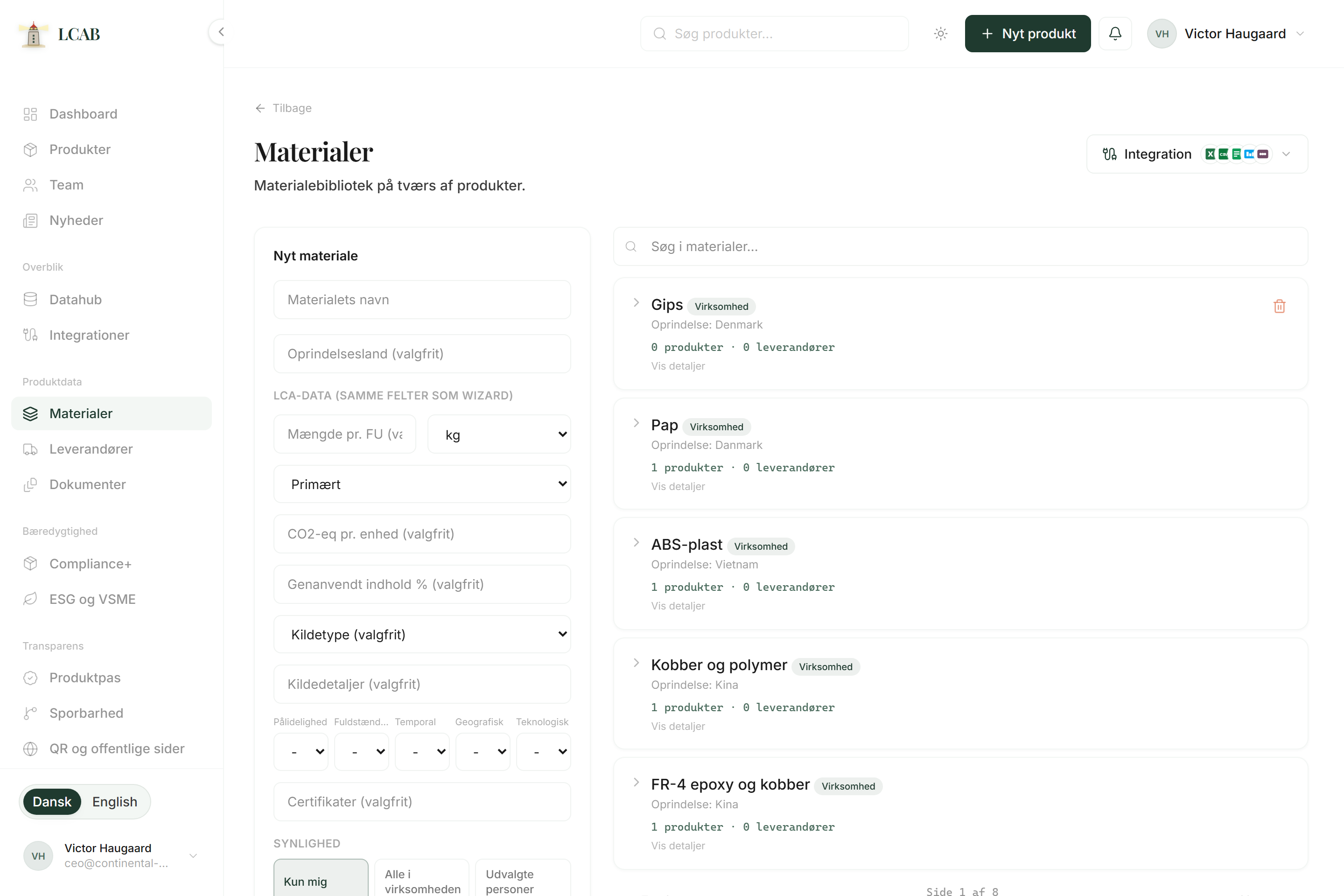
Material library

Used to create one shared truth about materials across products.

Instead of entering the same material again and again in new spreadsheets, you gather materials in a library, or import them via Integration. There you can register name, origin, and available environmental data, and reuse entries across products. That saves time, reduces errors, and makes it easier to keep data updated when a supplier changes the specification.

05

Suppliers

Used to gather supplier data that otherwise lives in emails, folders, and single files.

Supplier cards make it possible to keep track of country, certifications, linked materials, and documents. Via Integration → Excel → Extract data you can import whole lists at once. When a customer asks where a part comes from, the answer does not have to be dug out of the inbox. That is a practical foundation for traceability and for answering quickly under supplier pressure from CSRD-related customer demands.

06

Document center

Used for all product documentation, not only LCA reports.

Certificates, tests, EPD files, REACH or CE documentation, and supplier sheets can be gathered in one place and linked to product, material, or supplier. That means documentation is ready for audit, customer requests, or internal quality control, without needing to remember which folder held the latest version.

07

Compliance overview

Used to see how far you are, and what is still missing.

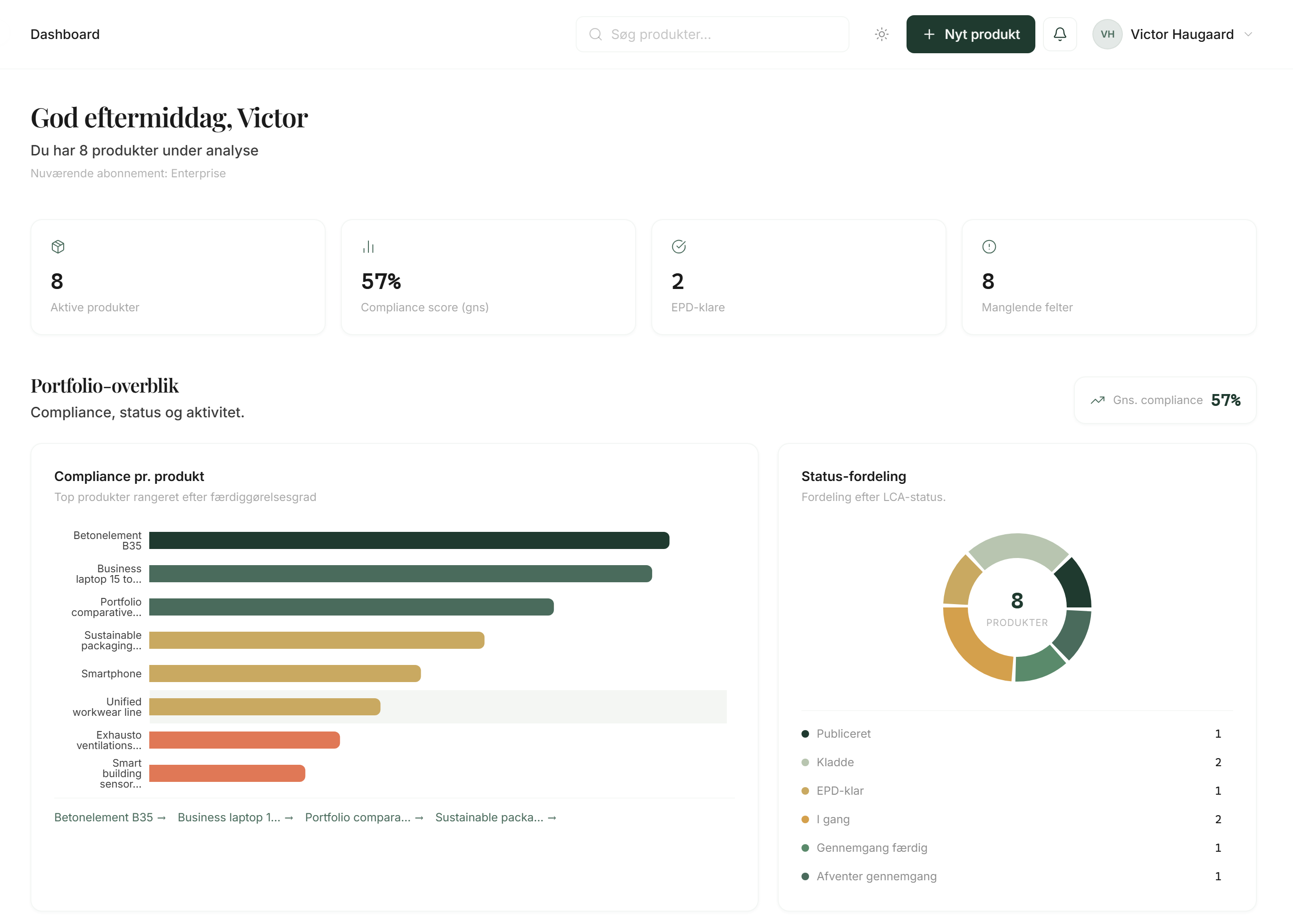
Compliance score and checklists help you follow ISO-related points, readiness for EPD or carbon footprint, and readiness for a digital product passport. The goal is not to promise certification. The goal is to make gaps visible in time, so you can prioritize next steps calmly before a customer or auditor asks.

08

Digital product passport

Used to prepare product data for future passport requirements under ESPR.

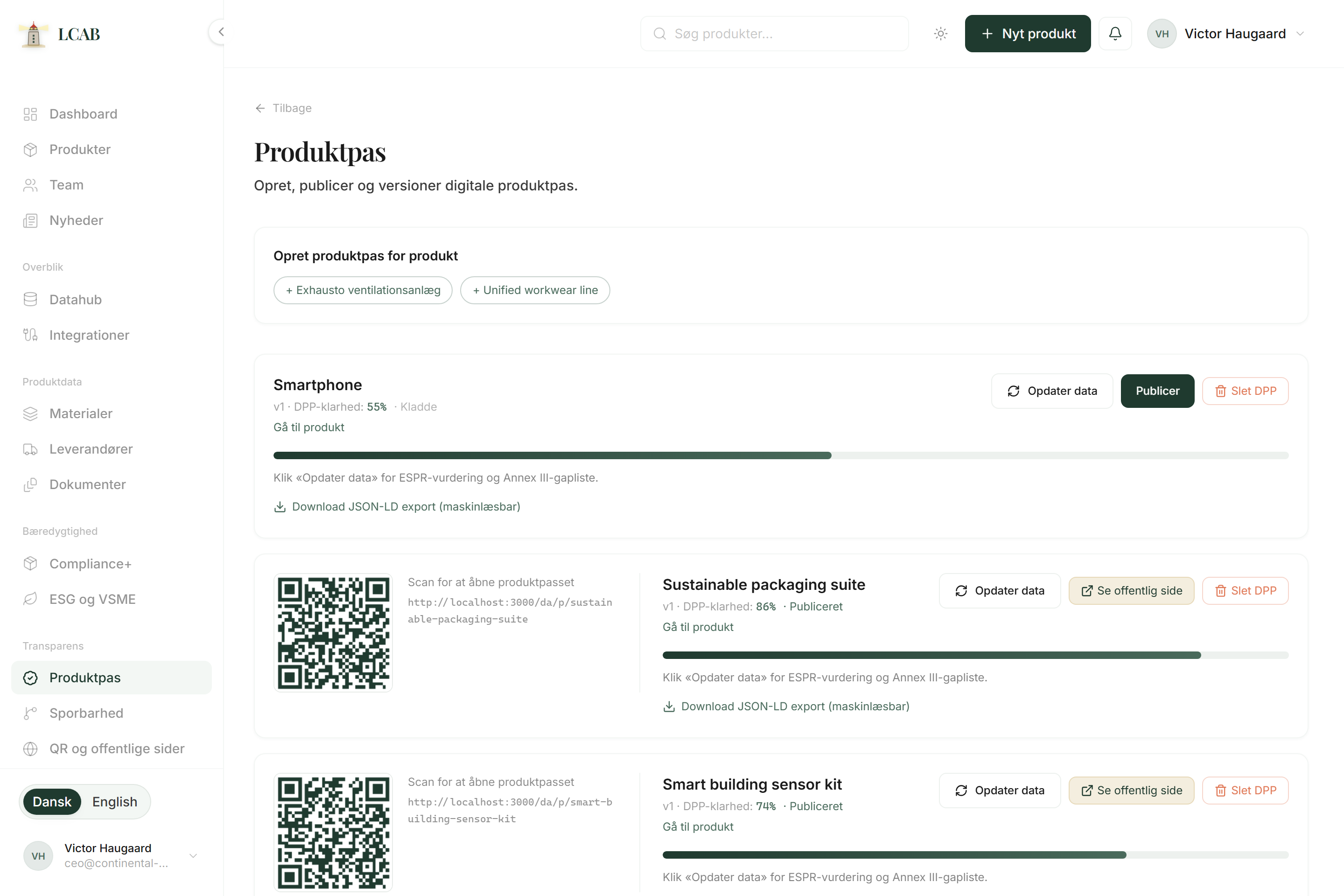
In LCAB you can work with passport readiness, publishing, and the public side of the product. It is about gathering the information a Digital Product Passport typically concerns: product identity, materials, environmental data, and traceability. That way the passport becomes a natural next step from data you are already structuring.

09

Traceability

Used to understand how product, materials, suppliers, documents, and LCA connect.

The traceability view makes relations visible. It is useful when new colleagues need to learn a product, when you must explain the value chain to a customer, or when you yourself need to check whether documentation actually covers what you think it covers. The product story no longer has to live in one persons head.

10

Public verification

Used when a recipient needs to check that an LCAB document is genuine.

When you issue a report, a document ID follows. The recipient can look up the ID and see the issued version. That builds trust in dialogue with customers and partners, because you are not only sending a PDF, but also a verifiable reference to the official document.

11

Team and collaboration

Used when several people in the company work on the same products.

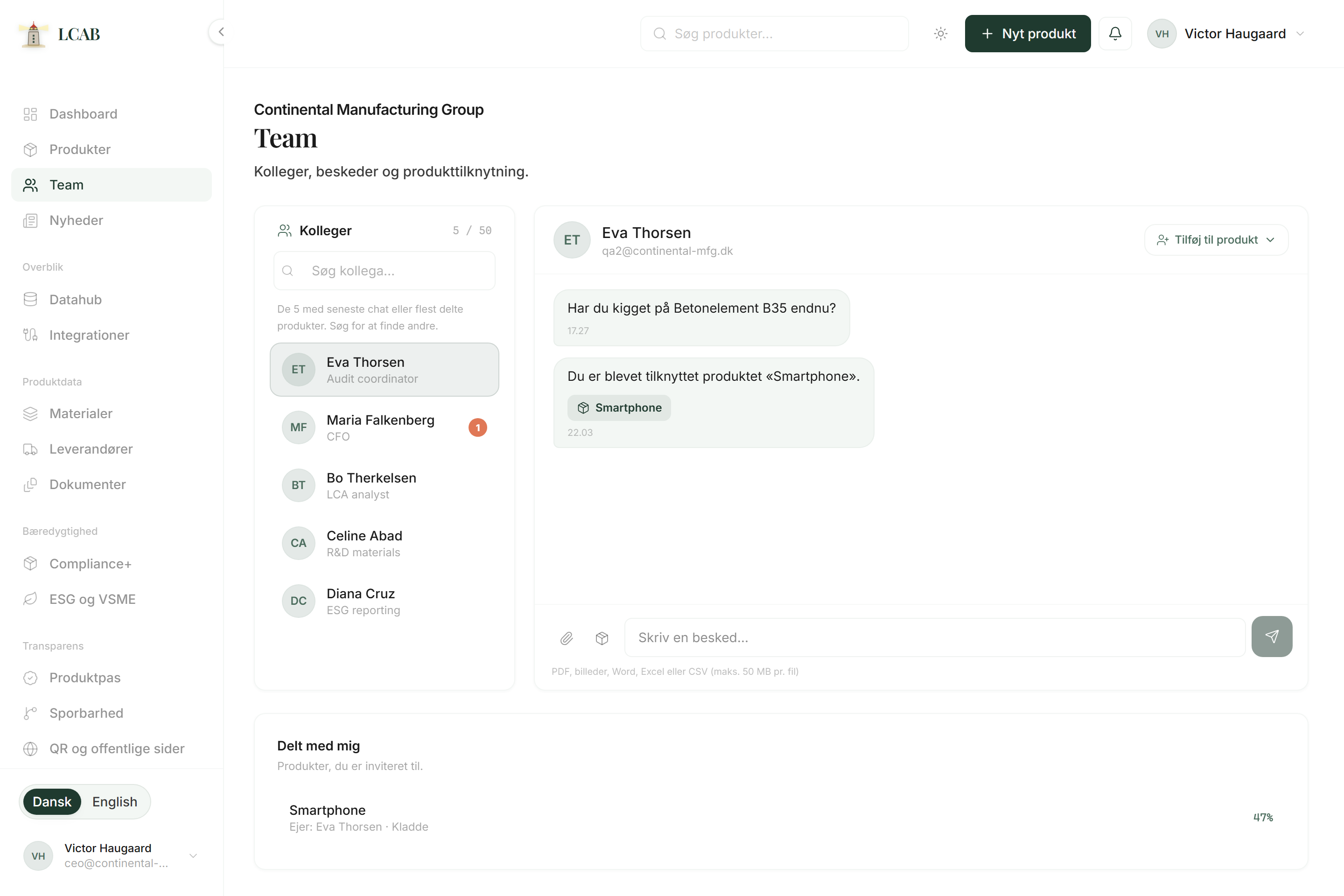
LCAB supports organization, roles, and product sharing so work can be distributed. That matches reality in many SMEs, where sustainability is not one persons full-time job, but a shared responsibility across product, purchasing, quality, and leadership.

06

Built for real organizations

Not every company has an internal sustainability department. Not every organization has dedicated LCA specialists. And not every team has time or resources to spend months learning heavy expert tools.

LCAB is designed for the real world: SMEs, manufacturers, importers, designers, and product teams that must document products because customers, tenders, or upcoming requirements expect it.

The platform suits both the first assessment and more routine work. The goal is the same at every level: make the process easier to navigate, so you can move forward with less uncertainty.

  • Sole traders and SMEs taking their first steps into sustainability documentation and needing a clear start.
  • Growing organizations that must meet customer requirements and pass data further in the value chain.
  • Consultants managing multiple projects and needing structure and reuse of data.
  • Larger companies seeking better consistency, traceability, and one shared place for product data.

Whether you are doing your first or your hundredth assessment, the ambition is to make the work clearer and more confident.

07

More than calculations

Many tools focus mainly on calculations. Calculations matter, but life cycle assessment is also about documentation, transparency, traceability, collaboration, and trust.

Organizations need more than a number. They need a way to manage the journey from first scope to finished report, and to find decisions, assumptions, and annexes later.

LCAB helps organize the work around the assessment so information stays structured, accessible, and easier to maintain over time. That is the difference between having done an analysis once, and having a system you can return to.

08

Built around confidence

One of the biggest challenges in sustainability work is uncertainty. Teams constantly ask whether they collected the right data, whether everything is documented correctly, whether it can withstand review, and whether something important was missed.

LCAB is designed to reduce that uncertainty by creating visible structure around the process. You can see what is done, what still needs attention, and how the assessment is progressing.

Confidence comes from clarity. And clarity comes from structure. When the next customer asks, the answer should not start with a chaos of files, but with an overview you have already built.

09

Developed by Windfeld Jensen Co.

LCAB is developed and maintained by Windfeld Jensen Co., a software company built around a simple belief: Technology should make work easier.

The company was founded on the idea that software should adapt to people and workflows, not the other way around. The same philosophy guides every part of LCAB.

We build software for the people who do the work. Sustainability is not only about data. It is about the people responsible for collecting, documenting, understanding, and acting on it.

Read more about Windfeld Jensen Co. here: www.windfeldjensen.com

10

Our mission

Our mission is simple: to make life cycle assessment and product documentation more accessible, more structured, more transparent, and significantly less frustrating.

We want organizations of all sizes to feel confident when working with sustainability data, environmental documentation, and life cycle assessment.

The future of sustainability should not belong only to those with the largest budgets or the largest teams. It should be accessible to everyone willing to take the journey. LCAB exists to help show the way.